Equipment failure isn’t the biggest threat during maintenance—unexpected startup is. Every year, hundreds of workers suffer severe injuries or fatalities because machinery energizes unexpectedly while being serviced. The solution isn’t advanced tech or costly overhauls. It’s systematic, well-executed lockout tagout safety training.
Lockout tagout (LOTO) isn’t just a procedural checkbox. It’s a critical control mechanism that protects workers from hazardous energy release. Yet, despite OSHA’s clear regulations and decades of enforcement, LOTO violations consistently rank among the top workplace safety citations. The root cause? Incomplete or ineffective training.
This is where real impact begins: with training that’s not only compliant but also practical, memorable, and embedded in daily operations.
Why Lockout Tagout Training Matters More Than You Think
Most companies treat LOTO as a one-time compliance requirement. Employees watch a video, sign a form, and get back to work. But energy control isn’t a spectator sport.
The danger lies in complacency. A maintenance technician bypasses a lock because "it’ll only take a minute." A machine operator restarts equipment without checking tags. A supervisor assumes training from two years ago still applies to a newly installed conveyor system.
These aren’t edge cases—they’re everyday realities that result in amputations, electrocutions, and crushing injuries.
LOTO training bridges the gap between policy and practice. It transforms abstract rules into muscle memory. When done right, it doesn’t just teach what to do—it builds a culture where safety is non-negotiable.
Consider this: OSHA estimates that proper lockout tagout procedures prevent 120 fatalities and 50,000 injuries annually. But only if the training is comprehensive, role-specific, and reinforced over time.
Core Components of Effective LOTO Safety Training
A high-impact LOTO program rests on four pillars: awareness, authorization, procedure, and verification. Training must address each.
#### 1. Understanding Hazardous Energy Sources
Workers must identify all forms of hazardous energy—not just electrical, but also mechanical, hydraulic, pneumatic, chemical, thermal, and gravitational. A compressed spring, a suspended load, or pressurized fluid can be just as deadly as live wires.
Training should include real equipment walkthroughs. For example, in a packaging facility, workers learn that a sealing machine stores residual heat and pressure even after shutdown. Without proper lockout, opening the unit for cleaning risks severe burns or sudden movement.
#### 2. Roles: Authorized vs. Affected Employees
Not all employees need the same level of training.
- Authorized employees perform maintenance and implement the lockout. They must know how to isolate energy, apply locks and tags, verify zero energy, and safely re-energize.
- Affected employees operate or use the equipment but don’t service it. They must recognize when lockout is active and understand not to interfere with locks or restart machinery.
Misclassifying roles is a common failure. A line operator who occasionally clears jams should be trained as authorized—not just affected—because they’re interacting with hazardous parts.
#### 3. Step-by-Step LOTO Procedures
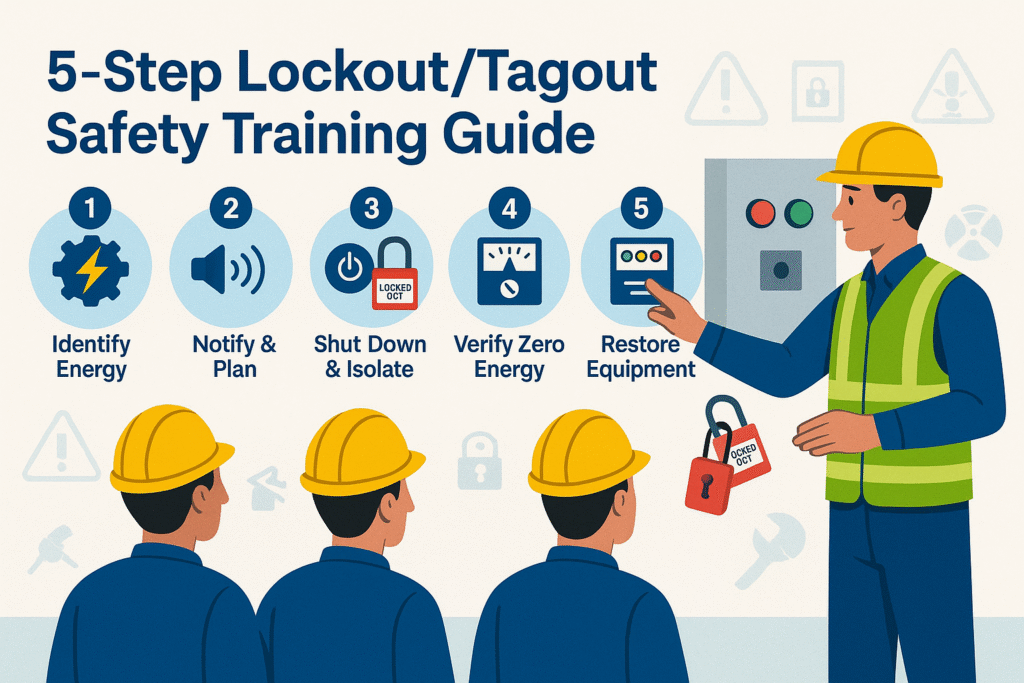
Training must cover the full sequence:
- Notify all affected personnel
- Shut down the machine properly
- Isolate all energy sources (valves, breakers, etc.)
- Apply lockout devices and personal tags
- Release stored or residual energy (bleed lines, block moving parts)
- Verify isolation (attempt to restart, check gauges)
- Perform the service
- Remove tools, re-energize only after clearance
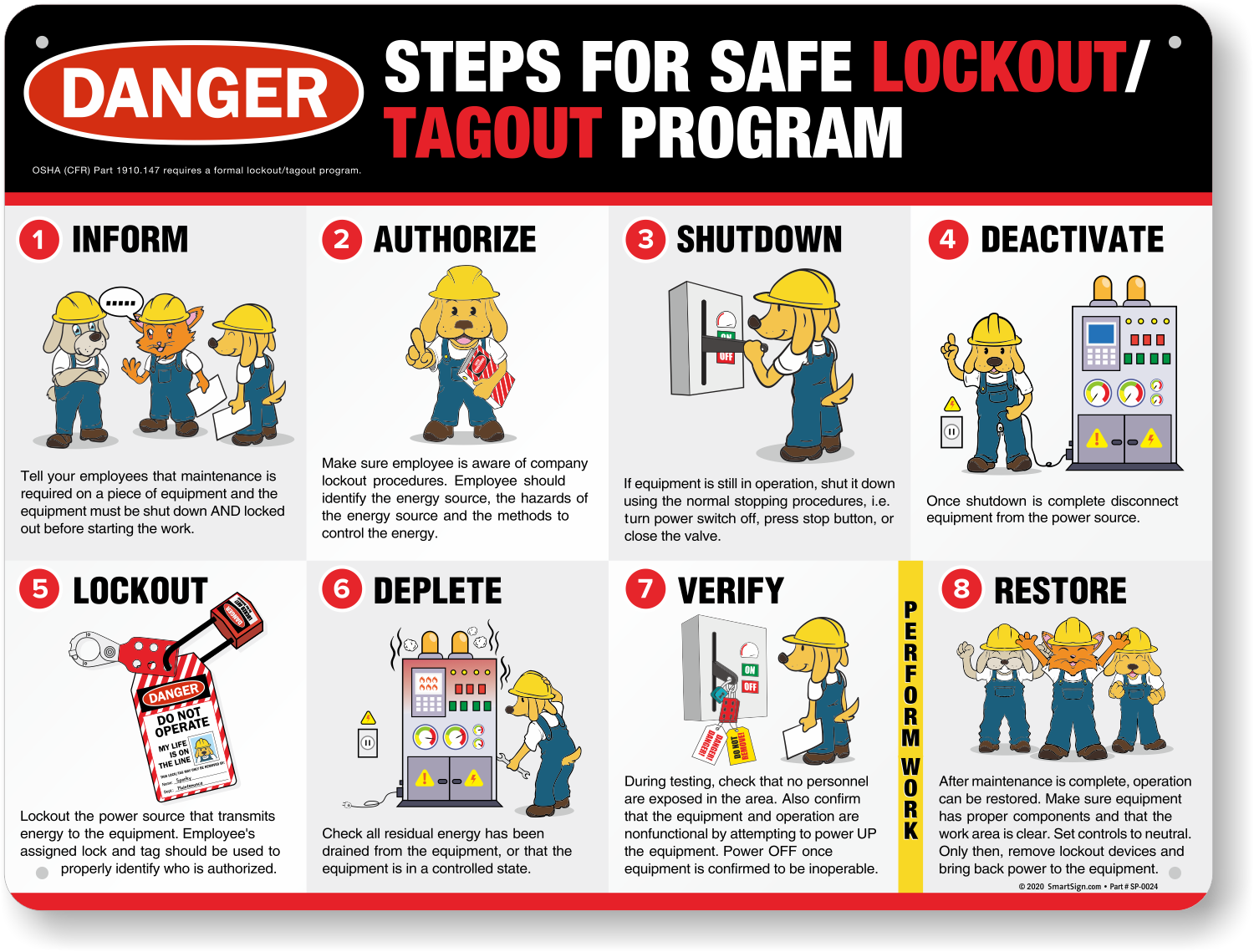
Each step should be role-played. Use simulated scenarios: what if the lock doesn’t fit? What if a coworker leaves their key in the lock? These drills expose gaps before they become incidents.
#### 4. Periodic Inspections and Reinforcement
OSHA requires annual inspections of LOTO procedures. But too often, this becomes a paperwork exercise.
Effective training turns inspections into learning moments. Supervisors observe employees performing lockout, identify deviations, and provide immediate feedback. The goal isn’t punishment—it’s correction.
One plant reduced LOTO errors by 78% after shifting from annual audits to quarterly hands-on reviews with refresher training.
Common LOTO Training Mistakes (And How to Fix Them)
Even companies with formal programs make critical errors. Avoid these pitfalls:
Mistake 1: One-Size-Fits-All Training Delivering the same session to electricians, machine operators, and janitorial staff dilutes relevance. Tailor content: electricians need electrical isolation techniques; operators need recognition and communication skills.
Mistake 2: Using Generic Videos Only Off-the-shelf videos often lack site-specific details. Supplement them with facility walkthroughs and real equipment demos. If your CNC machines have unique lock points, show them.
Mistake 3: Skipping Retraining After Changes New equipment, revised procedures, or staff turnover demand updated training. A technician trained on older hydraulic systems may not know how to isolate energy on a new servo-driven press.
Mistake 4: Ignoring Language and Literacy Barriers If 30% of your workforce speaks Spanish, training in English alone is ineffective—and unsafe. Use multilingual materials, visual aids, and hands-on practice to ensure comprehension.
Mistake 5: No Verification of Competency Signing a training sheet doesn’t prove understanding. Require employees to demonstrate the full LOTO process under observation before granting authorization.
Real-World LOTO Training Scenarios That Work
The best training mirrors real conditions.
Scenario 1: Conveyor Jam in a Food Processing Plant A line operator notices a blockage. Instead of reaching in, they follow protocol: shut down the line, alert maintenance, and wait. The authorized technician arrives, locks out the main drive motor and feeder system, verifies isolation, clears the jam, and removes the lock only after confirming the area is clear.
Training includes simulating a missing lock—what to do when the standard device doesn’t fit. Workers learn to use alternative lockout methods or escalate to supervisors instead of improvising.
Scenario 2: Preventive Maintenance on a Hydraulic Press Before servicing, the technician must isolate electrical power, close and lock hydraulic valves, and block the ram from falling. Training emphasizes stored energy: even with pumps off, pressurized fluid can cause sudden movement.
Workers practice bleeding lines and using mechanical restraints—procedures often overlooked in basic training.
Scenario 3: Shift Handover During Extended Repairs A repair spans multiple shifts. The outgoing technician removes their lock only after briefing the incoming worker, who applies their own lock. Training includes tag clarity: “Do Not Operate – Motor Bearing Replacement in Progress – Jane Doe, Ext. 445.”
This prevents the all-too-common mistake of re-energizing equipment mid-repair because no one knew work was ongoing.
Integrating LOTO Training Into Safety Culture
Training doesn’t end with a certificate. It’s part of a living safety system.
Start with leadership involvement. When managers participate in drills and ask, “Have you locked it out?” instead of “Hurry up,” the message lands.
Use near-miss reporting to reinforce learning. If someone almost restarted tagged equipment, treat it as a training opportunity—not just a warning.
In one manufacturing facility, supervisors began monthly “LOTO Spot Checks,” observing random employees performing lockout. Results were shared in safety meetings—not to shame, but to celebrate correct procedures and correct errors.
Another site introduced “LOTO Champions,” experienced workers who mentor new hires and conduct peer reviews. Peer accountability increased compliance more than top-down audits.
Tools and Equipment That Support Effective Training
While training is human-driven, the right tools make procedures clearer and safer.
| Tool | Purpose | Training Application |
|---|---|---|
| Lockout Hasps | Allow multiple locks on one isolation point | Train teams on group lockout procedures |
| Valve Lockouts | Prevent reopening of gas, steam, or fluid lines | Demonstrate isolation in piping systems |
| Circuit Breaker Locks | Secure electrical disconnects | Practice electrical LOTO during drills |
| Tagout Devices | Communicate warnings and ownership | Teach proper tag completion and visibility |
| Lockout Stations | Centralized kits with locks, tags, and hasps | Use in drills to simulate real-world access |
Invest in durable, standardized equipment. If workers have to hunt for a lock or improvise with zip ties, the system fails.
Building a Sustainable LOTO Training Program
Compliance isn’t a one-time event. It’s a cycle:
- Initial Training – Role-specific, hands-on, documented
- Annual Refreshers – Reinforce knowledge, update for changes
- Inspections – Observe real procedures, correct deviations
- Incident Reviews – Analyze near-misses and failures
- Continuous Improvement – Adapt training based on feedback and data
One refinery reduced LOTO-related incidents to zero over three years by auditing every step, involving frontline workers in procedure design, and rewarding safety compliance.
The result? Faster, safer maintenance—and OSHA citations dropped by 90%.
Final Takeaway: Training That Saves Lives
Lockout tagout safety training isn’t about passing an audit. It’s about ensuring every worker goes home unharmed.
The most effective programs don’t rely on memory alone. They combine clear procedures, realistic practice, and a culture where safety is personal. Workers don’t lock out because a rule says so—they do it because they’ve seen what happens when someone doesn’t.
Start today: audit your current training, involve your team in improvements, and turn LOTO from a compliance task into a lifeline.
FAQ
What is the purpose of lockout tagout safety training? LOTO training ensures workers can safely isolate machinery from hazardous energy sources during maintenance, preventing accidental startup and serious injury.
Who needs lockout tagout training? Both authorized employees (who perform maintenance) and affected employees (who operate equipment) require training, though the depth differs by role.
How often should LOTO training be conducted? Initial training is required, followed by annual refresher training and retraining whenever procedures, equipment, or personnel change.
Can tagout be used instead of lockout? Tagout alone is allowed only if a lock cannot be applied, but it provides less protection. OSHA requires a tagout program to include additional safety measures.
What happens if LOTO procedures are not followed? Failure to follow LOTO can result in severe injuries or fatalities, as well as OSHA fines exceeding $100,000 per violation in cases of willful noncompliance.
Do temporary repairs require lockout? Yes. Any service or maintenance task that exposes workers to hazardous energy—including clearing jams or making adjustments—requires proper lockout.
Is online LOTO training sufficient? Online courses can be part of training but must be supplemented with hands-on practice and site-specific instruction to be effective.
FAQ
What should you look for in Lockout Tagout Safety Training: Protect Workers, Prevent Accidents? Focus on relevance, practical value, and how well the solution matches real user intent.
Is Lockout Tagout Safety Training: Protect Workers, Prevent Accidents suitable for beginners? That depends on the workflow, but a clear step-by-step approach usually makes it easier to start.
How do you compare options around Lockout Tagout Safety Training: Protect Workers, Prevent Accidents? Compare features, trust signals, limitations, pricing, and ease of implementation.
What mistakes should you avoid? Avoid generic choices, weak validation, and decisions based only on marketing claims.
What is the next best step? Shortlist the most relevant options, validate them quickly, and refine from real-world results.